Retired Yoruba Midwife Reveals a Forgotten 14-Day Home Ritual That Helps Married Nigerian Women Rediscover Their Desire and Reignite Their Marriages — Naturally

You're lying there in the dark, pretending to be asleep.
Your husband is beside you. You can feel the warmth of his body. You know what he wants. And somewhere deep inside you — somewhere you've stopped being able to reach — you feel absolutely nothing.
What is wrong with me?
Not long ago, you would have reached for him first. You would have looked forward to this. The touch. The closeness. The feeling of being wanted and wanting back. That woman existed. You know she did, because you remember her.
But something happened after the children came. After the hospital, the sleepless nights, the breastfeeding, the cooking, the school runs, the work meetings, the in-laws, the church commitments, the thousand invisible tasks that only you seem to see. Something inside you — that soft, warm, alive part of you — went very, very quiet.
Maybe I'm just tired.
That's what you told yourself at first. You would rest, and it would come back. But it never came back.
So you started going to bed earlier. Just to avoid the conversation. You started wearing longer nightgowns. You started pretending your phone needed attention right up until sleep saved you. And every time your husband reached for you and you had to gently, silently push him away — you felt the guilt settle a little deeper into your chest.
I love him. I genuinely love this man. So why can't I feel anything?
You've prayed about it. You've fasted about it. You've Googled it at 2am in the bathroom so your husband wouldn't see. Everything you found was written for foreign women in foreign marriages, talking about "scheduling intimacy" and "date nights" as if your life isn't already completely full to the point of breaking.
You've never told a single soul. Not your mother — because what would she even say? Not your best friend — because you're the one everyone else comes to for strength. Not your pastor — you wouldn't even know how to form the words without your face burning.
You've started to quietly wonder: Is this permanent? Is this just who I am now?
And the worst part — the part that keeps you awake longer than anything else — is watching your husband try to understand. Watching him pull back. Watching something dim behind his eyes when you turn away again. And not being able to explain it, because you don't understand it yourself.
You are not broken. You are not cold. You are not a bad wife. And this is not a spiritual attack.
Drop everything you are doing now and listen to every word I'm about to say.
Our grandmothers knew something we have forgotten.
Before the clinics, before the prescription pads, before the Instagram vendors selling bottles of God-knows-what — our grandmothers had a system. They understood the female body in ways that no modern textbook has ever fully captured. They understood what childbirth takes from a woman. They understood that desire is not a character trait. It is a physical state. And they knew exactly how to restore it.
That knowledge has been buried. Buried under shame, under modernity, under the lie that a woman who doesn't want her husband simply doesn't love him. But it hasn't died. Not completely.
Hi. My name is Adunola.
First thing you should know about me: I am not a doctor. I am not a therapist, a herbalist, or a relationship coach. I am a 36-year-old wife and mother from Ibadan, Nigeria, who lived with this problem for three years in complete silence — and then stumbled on the answer in the most unexpected place imaginable.
And I need to tell you this story properly. Because if you don't hear the full story, you won't believe the answer.
A second, more casual/personal photo of Adunola.
Ideal size: 400×500px. Should feel warm and real — perhaps at home or with a journal.
My name is Adunola. This is the story I never planned to tell anyone.
I am 36 years old. I live in Ibadan with my husband Biodun, our five-year-old daughter Temi, and our two-year-old son Dayo. From the outside, our marriage looks exactly like what it's supposed to look like. We go to church together every Sunday. We don't fight. The children are healthy and happy. Biodun is a good man — a genuinely good man — and I love him.
But for three years, something had been dying inside our bedroom. And I didn't know how to stop it.
It started after Dayo was born.
With my first pregnancy, there had been a natural, gradual shift — my body was tired, I was adjusting, I assumed things would go back to normal. And mostly they did, within a year. But after my second child — after the second delivery, the second round of breastfeeding, the second set of sleepless nights layered on top of an already depleted body — something didn't come back.
Biodun would reach for me in the night and I would feel — nothing. No warmth. No response. Not even the faintest flicker. It was like trying to start a car with a completely dead battery. You can turn the key as many times as you want. Nothing is going to happen until you address the actual problem.
But I didn't know what the actual problem was. So I just pushed through.
Just let it be over quickly. He deserves this. You're his wife. Stop being selfish.
That voice in my head made everything worse. Because "pushing through" without feeling anything doesn't bring you closer to your husband. It makes you feel invisible inside your own body. It makes you feel like a fraud. And it quietly, slowly, builds a wall of resentment you didn't mean to build and don't know how to take down.
By the time Dayo was eighteen months old, Biodun had stopped reaching for me altogether. Not dramatically. Not with a big conversation or an argument. Just — quietly. The way a man does when he's tired of being turned away and has decided to stop showing the wound.
That broke my heart more than anything else.
He thinks I don't love him anymore. He thinks something is wrong with our marriage. And I cannot explain to him what I don't understand myself.
Before I found the answer, I tried everything I could find. Let me be honest with you:
1. Blood tonic and multivitamins from the chemist. I took them faithfully for three months straight. My energy improved slightly. My desire did not move one inch.
2. A herbal mixture from an Instagram vendor. I spent ₦8,500 on a bottle of something that smelled like engine oil and tasted worse. Nothing happened except mild stomach upset for four days and a lesson learned about trusting strangers on the internet.
3. Romantic getaways with my husband. We went to a hotel in Lekki for our anniversary — Biodun's idea, bless him. It helped for one night. One night of feeling something again, like being given water when you're dying of thirst, and then snatched away. We came home and within a week everything was exactly as before.
4. Praying and fasting. I genuinely believed for almost a year that what I was experiencing was a spiritual attack. I fasted twice. I attended a women's prayer retreat. My faith grew stronger — truly, it did. But my desire did not return. And eventually I had to accept that God was not going to send this particular answer from the sky. He was going to send it through a person.
5. YouTube videos from American relationship therapists. They talked about "scheduling intimacy" and "love languages" and "communicating your needs." All of it written for women living in two-bedroom apartments with no extended family, no domestic pressure, no cultural obligation pressing down on them from every side. None of it addressed what was happening inside my body. None of it felt written for a Nigerian woman.
6. Just pushing through and pretending. The worst strategy. It made me feel worse about myself, more disconnected from my own body, and quietly resentful of something I couldn't even name. I would lie there counting the ceiling tiles, going somewhere else in my mind until it was over. Then feeling ashamed for the rest of the day.
By December of last year, I had run out of ideas. I had started to quietly accept that this was simply my life now — that some part of me had gone and I would never get it back.
Then we traveled to Ogbomosho for Christmas.
The gathering at Biodun's family compound was loud and beautiful and completely overwhelming. Food everywhere. Children screaming. Relatives arguing about the Super Eagles. Music from three different houses blending into cheerful chaos.
I slipped away from the crowd to sit under the big mango tree at the back of the compound. I needed quiet. I was exhausted in a way I couldn't explain to anyone — not physically, not exactly, but in that deeper place that has no name. The place where a woman carries everything she is not allowed to put down.
Mama Kikelomo came and sat beside me without being invited.
She is 79 years old — Biodun's grandmother, though everyone calls her Mama. She was a traditional birth attendant for over thirty years, what we used to call an ìyá àbiye. She delivered more than 400 babies in her community. She has the kind of presence that makes a room go still the moment she walks in — not because she demands attention, but because she simply carries more weight than most people.
She sat beside me and said nothing for a long time. Just looked out at the compound with those sharp, quiet eyes.
Then she looked at me and said, in Yoruba:
"Ina rẹ ti parun. Ṣugbọn ko ti ku."
Your fire has gone out. But it has not died.
I didn't know whether to laugh or cry. I asked her how she knew. She said she had seen it a hundred times in the women she attended after childbirth. She said it had a name in the old language. She said our grandmothers knew exactly what to do about it — but that knowledge had been buried under shame and modernity and the lie that a woman who doesn't want her husband simply doesn't love him.
"Nobody told you that your body was emptied," she said. "They handed you a baby and told you to be grateful. Nobody said — you must now refill yourself or you will have nothing left to give."
She told me to come back the next morning. Alone. Without my phone.
I was there by 7am.
She talked to me for three hours.
Mama Kikelomo explained that what I was experiencing had nothing to do with love and everything to do with what pregnancy, childbirth, breastfeeding, and the invisible weight of Nigerian womanhood had done to my body's hormones. She told me that our grandmothers understood something that modern medicine has only recently started to confirm — that a woman's desire lives in her body first. And if the body is depleted, exhausted, and starved of specific nourishment, desire cannot exist, no matter how strong the love is.
It is not a character flaw. It is not a spiritual failure. It is a body that has been emptied and never told how to refill.
She walked me through a 14-day restoration system that women in her community had used for generations. It combined:
- Specific natural preparations made from ingredients found in every Nigerian market
- A simple nightly body ritual that takes less than ten minutes
- A way of releasing the emotional weight that physically blocks response
- A gentle daily progression that moves from emotional reconnection back to physical desire — without pressure, without performance, without pretending
She made me write everything down in a small notebook. She said:
"Don't let this knowledge die with me again."
I went home and I followed everything exactly as she said.
The first three days, I felt nothing different. I almost stopped. I thought — this is what I always do. I try something, I hope, nothing changes, I give up.
But I kept going.
By Day 5, something small happened. I was in the kitchen, chopping onions, and Biodun came in to get water. And I noticed him. Not dramatically. Not like a film. Just — a warmth. An awareness. The way you might suddenly notice a song playing softly in the background that you realize you've liked all along. It was so small I almost dismissed it.
But I didn't. I held onto it like a matchstick flame in the wind.
By Day 9, something I hadn't done in over two years happened: I reached for him first.
Not because I was pushing through. Not because I felt I should. But because I actually wanted to. The want was there — real and warm and entirely mine.
By Day 14, I felt like a woman I had forgotten existed had quietly walked back into the room and sat down.
Biodun noticed the change before I said a single word about it.
On Day 9, he looked at me across the kitchen with an expression I hadn't seen in years. Then he said:
"Ade, what is happening to you? You are glowing. You look like the woman I married."
I just smiled. I wasn't ready to explain it yet.
Three days later, I told him everything. He sat quietly for a long time. Then he said:
"We need to make sure every married woman in Nigeria knows about this."
And that is exactly why I'm writing this today.
I have since quietly shared Mama Kikelomo's protocol with women I know. Here is what three of them told me:
Funmilayo, 34, Lagos: "I thought I was the only one. I didn't even know this kind of thing could be fixed naturally. By Day 8 I cried happy tears."
Chisom, 39, Port Harcourt: "My husband actually asked me if I'd started taking a new supplement. I told him — something like that. I wasn't lying."
Amira, 41, Abuja: "Three years I lived like this. Three years. I want to send this to every woman I know."
After that Christmas, women from the family gathering kept calling me. Word had spread — the way word does in Nigerian families, through whispers and cousins and aunties who say "don't tell anyone but" and then tell everyone.
I couldn't speak to each one individually. I couldn't keep calling and messaging and explaining every detail from my notebook. And I was afraid the knowledge would get distorted — the way things do when passed from mouth to mouth.
So I did something. I sat down, spent months going back through everything Mama Kikelomo taught me, researched every single remedy against the latest science, and compiled it all — every step, every ingredient, every timing detail, every emotional tool — into one complete, clear, easy-to-follow PDF guide.
I put everything inside — the full ritual, the shopping list with local market names, the exact steps and quantities, what to do on each of the 14 days, what to avoid, and how to know it's working.
Introducing...
How Married African Women Are Restoring Lost Desire in 14 Days Using an Ancient Method Finally Explained by Science
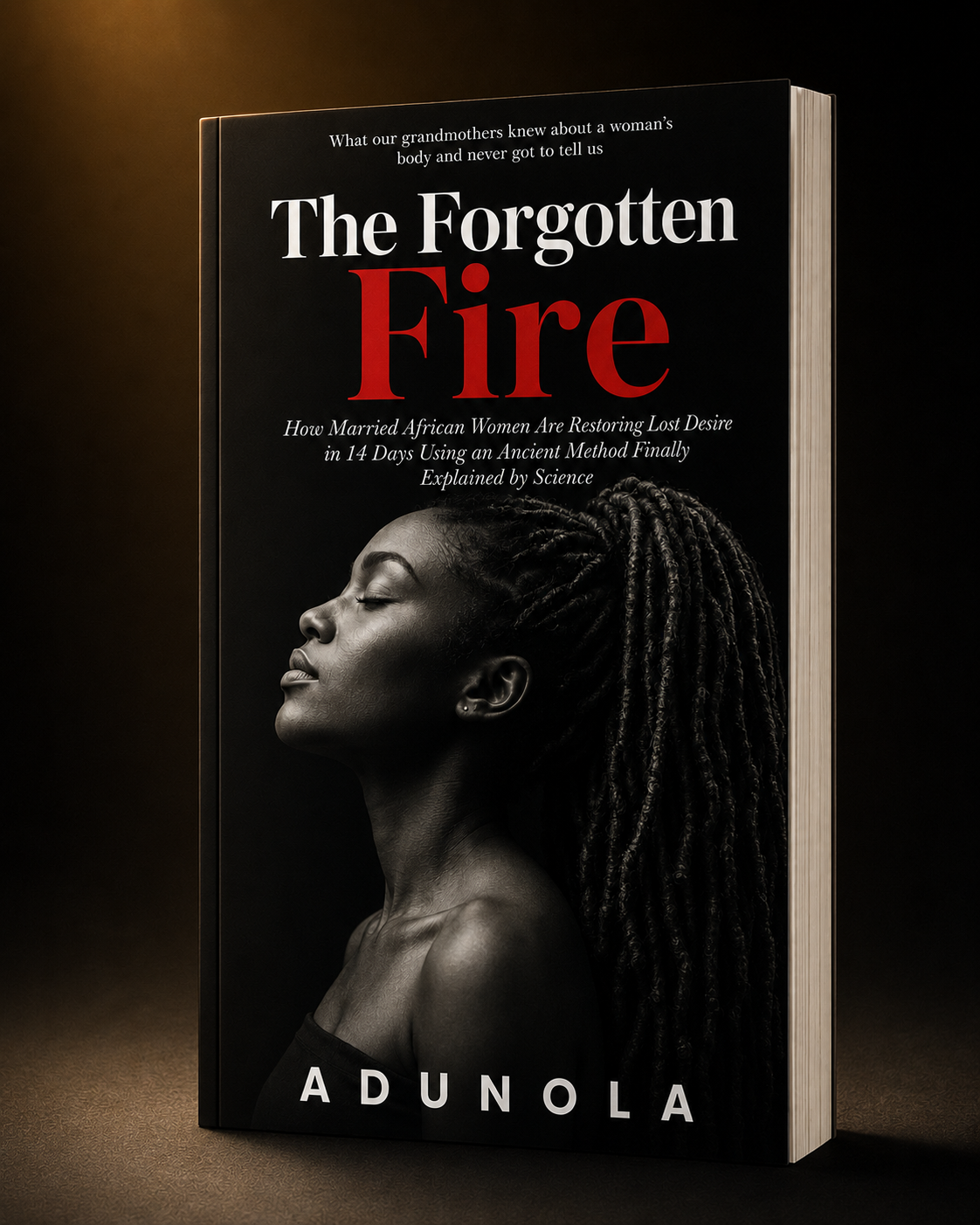
Inside This Guide, You'll Discover:
- Why your fire really went out — the hormonal truth nobody told you. The three specific hormonal changes that kill female desire after marriage and childbirth, explained in plain, everyday language — no medical jargon, just the real answer you've been searching for. — Pg. 4
- The 30-Minute Reset Drink — the single most powerful natural preparation for female desire you can make today from ingredients costing less than ₦1,500. Exact quantities and preparation instructions included. You can make this today. — Pg. 9
- The 14-Day Forgotten Fire Protocol — your complete, day-by-day restoration system combining natural remedies, the nightly Body Awakening Ritual, and the Intimacy Ladder that moves you gently from emotional reconnection back to physical desire — without pressure, without performance, without pretending. — Pg. 13
- The Emotional Audit — releasing what's blocking your body. A guided one-page process to identify and release the specific emotional weight of guilt, resentment, and unspoken needs that are suppressing your desire more than any hormone ever could. — Pg. 28
- The Reconnection Conversation Scripts — five natural, pressure-free scripts for reintroducing intimacy with your husband at each stage of your 14 days, with no awkwardness, no rejection, and no performance pressure. — Pg. 33
- The Nigerian Kitchen Libido Shopping List — every ingredient you need for the full protocol, with local market names in English and Yoruba, estimated costs, and exactly where to find them in Lagos, Ibadan, Abuja, and other major cities. — Pg. 38
- The Monthly Maintenance Ritual Card — one page you save on your phone forever, so that your fire never goes out again. — Pg. 42
And the best part? You don't need to travel anywhere, book any appointments, or explain yourself to anyone. You don't need to spend hundreds of thousands on treatments or spend years trying to figure out what's wrong. It's the same simple system that worked for me — and has now quietly worked for over 200 women I've shared it with.
💬 Real Women. Real Testimonials.
Just So You Know... Putting This Guide Together Cost Me Over ₦340,000
I'm not telling you this to impress you. I'm telling you because I want you to understand what is actually inside this guide — and why the knowledge inside it is worth far more than what I'm about to charge you.
Here is what went into building it:
- A professional medical writer who helped me translate Mama Kikelomo's teachings into plain, accurate language — ₦85,000
- Two rounds of editing and fact-checking to confirm every herbal remedy against current scientific literature — ₦60,000
- Six weeks of personal testing and documentation, tracking every day and result — priceless, but my time matters
- A professional designer who laid out the guide so it's beautiful, clear, and easy to follow on phone or laptop — ₦55,000
- Website, payment integration, hosting, and customer support infrastructure — ₦140,000
That comes to ₦340,000 to create this guide. And I haven't even counted the three hours Mama Kikelomo gave me, or the thirty years of knowledge she carries in her hands.
I'm not going to charge you ₦340,000.
I won't even charge you ₦100,000.
Not even ₦50,000.
In fact, you won't even pay the original price of ₦19,500.
₦19,500
₦9,500
One-time payment. Instant PDF download. No monthly charges. No subscription.
⚡ This discounted offer is ONLY for the first 30 women who purchase today.
Once those 30 slots are gone, the bonuses will be sold separately.
INSERT
BONUS 1
MOCKUP
HERE
400×560px
BONUS 1 — FREE for the First 30 Buyers:
"Rekindling After Children — The New Mother's Guide to Reclaiming Desire After Birth"
Why childbirth changes your body's desire hormones and exactly how to restore them naturally. A complete standalone guide specifically for mothers whose desire disappeared during pregnancy or breastfeeding. If your fire went out the moment your baby arrived — this was written for you.
Value: ₦7,500 — FREE when you buy today
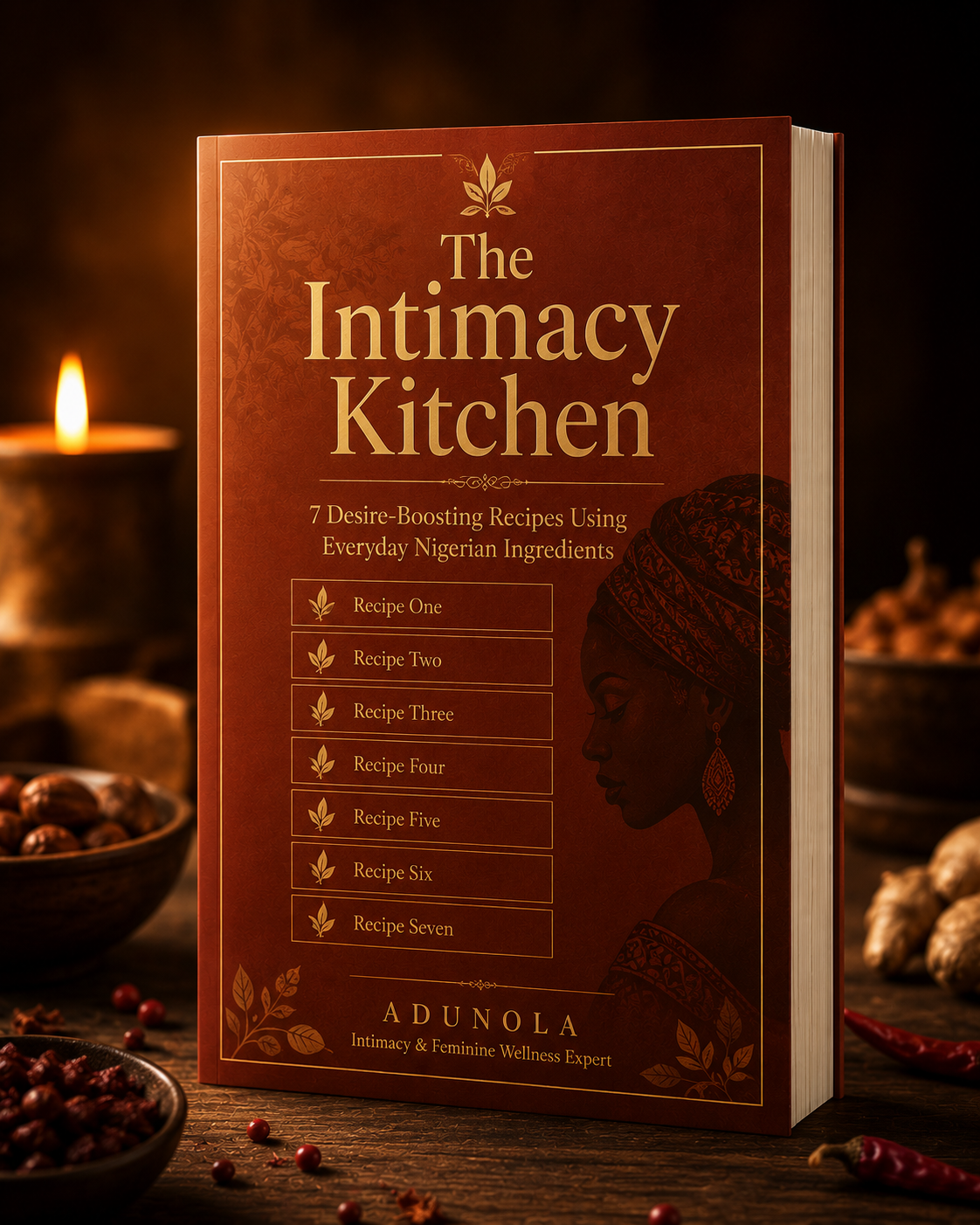
BONUS 2 — FREE for the First 30 Buyers:
"The Intimacy Kitchen — 7 Desire-Boosting Recipes Using Everyday Nigerian Ingredients"
Simple meals, drinks, and preparations you can make this week using ingredients from your local market to naturally support your body's restoration. Includes local names in English and Yoruba, estimated costs, and preparation times. Food has always been medicine — this guide shows you exactly how.
Value: ₦5,500 — FREE when you buy today

Total Bundle Value: ₦32,500 — Yours Today for Just ₦9,500
Look Who Else Is Already Getting Their Fire Back...
Only 7 bonus slots remaining out of the first 30.
Bear in mind — you are not the only one viewing this page right now.
Still Feeling Unsure? I Completely Understand.
Which is why I'm making you a bold, risk-free promise:
Use The Forgotten Fire Protocol for a full 30 days. Follow the system exactly as I've laid it out. If at the end of those 30 days you haven't noticed a single shift — not a warmth, not a noticing, not a flicker of something returning — write to me and I will refund every kobo. No questions. No awkward conversations. No paperwork.
I am this confident because I know what this knowledge did for me. And for the women who have followed it since. The only thing I ask is that you actually try it.
"Ina rẹ ti parun. Ṣugbọn ko ti ku." — Your fire has gone out. But it has not died.
Yes! I'm Ready to Restore My Fire — Guarantee Me!
💬 More Women, More Results
You Have Two Options Right Now
✅ Option 1 — Take Action
Get The Forgotten Fire today. Follow the 14-day protocol. Feel the warmth returning. Watch your husband's face change. Remember what it feels like to be fully, completely, joyfully alive in your own body again. Rebuild the intimacy your marriage deserves — naturally, quietly, powerfully. For ₦9,500 and 14 days, you could be a completely different woman in a completely different marriage.
❌ Option 2 — Close This Page
Go back to pushing through. Go back to lying in the dark and counting the ceiling tiles. Keep spending money on blood tonics that don't address the root. Keep watching your husband quietly withdraw. Keep wondering if something is permanently broken inside you — when it isn't, when it never was. Maybe you'll find another solution somewhere. Maybe. Or maybe you'll be in the same place in six months, or a year, or three years from now. The clock is ticking.
Maybe God placed this page in front of you today for a reason. Who knows?
🔒 100% Secure Payment | Instant Delivery | Pay by Card, Bank Transfer, or USSD
Share Your Experience: